
Pasquotank Prison Release Destinations
Pasquotank Correctional Institution belongs to the North Carolina Department of Adult Correction. It holds sentenced state prisoners within a statewide system. A Camden court case can lead to imprisonment there, but the prison sits in Pasquotank County and is not a Camden County facility. NCDAC may transfer a prisoner to another institution, so the sentencing county does not determine the final place of confinement.
A person can leave Pasquotank Correctional Institution for post-release supervision, eligible parole, expiration of sentence, transfer inside NCDAC, sheriff pickup, federal custody, or another authorized movement. Inactive incarceration may coexist with active supervision. That combination means the person left prison but remains under NCDAC supervision in the community. A movement to another custodian is not community release.
Read the actual release date, last movement, and supervision status together. One NCDAC label rarely tells the whole release story.
Confirm a Pasquotank Prison Release
The NCDAC Offender Public Information search is the correct public route. It covers state prisoners, probationers, parolees, and historical state records back to 1972. NCDAC expressly excludes county-jail information, so it should not be used to find an Albemarle District Jail release unless the person later entered state prison or state supervision.
- Enter the NCDAC offender number when known. Otherwise use the least amount of name information needed and start with the All status.
- Try Inactive for a completed incarceration or supervision record, and Active Probationer/Parolee when community supervision is expected.
- Use birth date, age, race, sex, offense, and dates to distinguish a namesake.
- Open the offender number and read Inmate Status separately from Probation/Parole/Post Release Status.
- Compare Actual Release Date, Projected Release Date, Last Movement and date, sentence status, and supervision office.
After release, the actual date and last movement are stronger than a prior projection. The statewide search route and status distinctions are also covered in the Camden County released inmate lookup.
Pasquotank Release Search Fields
NCDAC combines search criteria with AND logic. Too many fields can hide a valid match. The help material recommends the offender number as the fastest route and accepts that number without leading zeroes. Name searches support partial names and a sounds-like surname option.
| Field or filter | Best use | Release meaning |
|---|---|---|
| All | Broad first search | Returns active and inactive state records |
| Active Inmate | Current state confinement | Does not indicate release |
| Active Probationer/Parolee | Community supervision | May coexist with completed prison custody |
| Inactive | Former prison or supervision record | Requires dates and movement for context |
| Offender number | Most precise identity route | Opens the detailed offender record |
The official NCDAC search gateway states the prison and supervision coverage boundary.

The county-jail exclusion explains why a local Camden booking and a state prison sentence require separate searches.
Pasquotank Actual Release Dates
Projected Release Date is an administrative projection based on the sentence and credits then recorded. NCDAC release policy also uses projected release date, or max out, for complete service with no parole or post-release reporting in the stated context. A projection is not proof that release happened on that day.
Credits, discipline, corrected sentence data, new or consecutive cases, jail credit, court orders, revocation, warrants, detainers, and recalculation can change the operative date or destination. Combined Records normally authorizes state releases. NCDAC policy also says staff try to transfer someone near the planned residence about 14 days before release, so the institution shown shortly before the date may change.
| NCDAC field | What it answers |
|---|---|
| Projected Release Date | The current administrative estimate, not completion proof |
| Actual Release Date | The recorded date state incarceration ended |
| Last Movement | The latest destination or kind of custody change |
| Supervision status | Whether probation, parole, or post-release supervision remains active |
Note: A sheriff pickup after prison release means the person left NCDAC incarceration but entered local custody instead of the community.
Pasquotank Release With Supervision
North Carolina uses distinct community statuses. Probation usually follows a court judgment without first completing a state prison term. Post-release supervision begins before termination of the maximum term for covered Structured Sentencing felons. Parole mainly applies to eligible older offenses and narrow statutory categories. These terms should not be merged.
An observed Camden NCDAC record demonstrated the layering. It showed inactive incarceration, an actual and projected release date, a parole or return-to-parole movement, and active supervision through a District 1 unit. The example confirms that an active label can describe supervision after release rather than prison confinement.
The observed NCDAC release record is captured below as a field example.
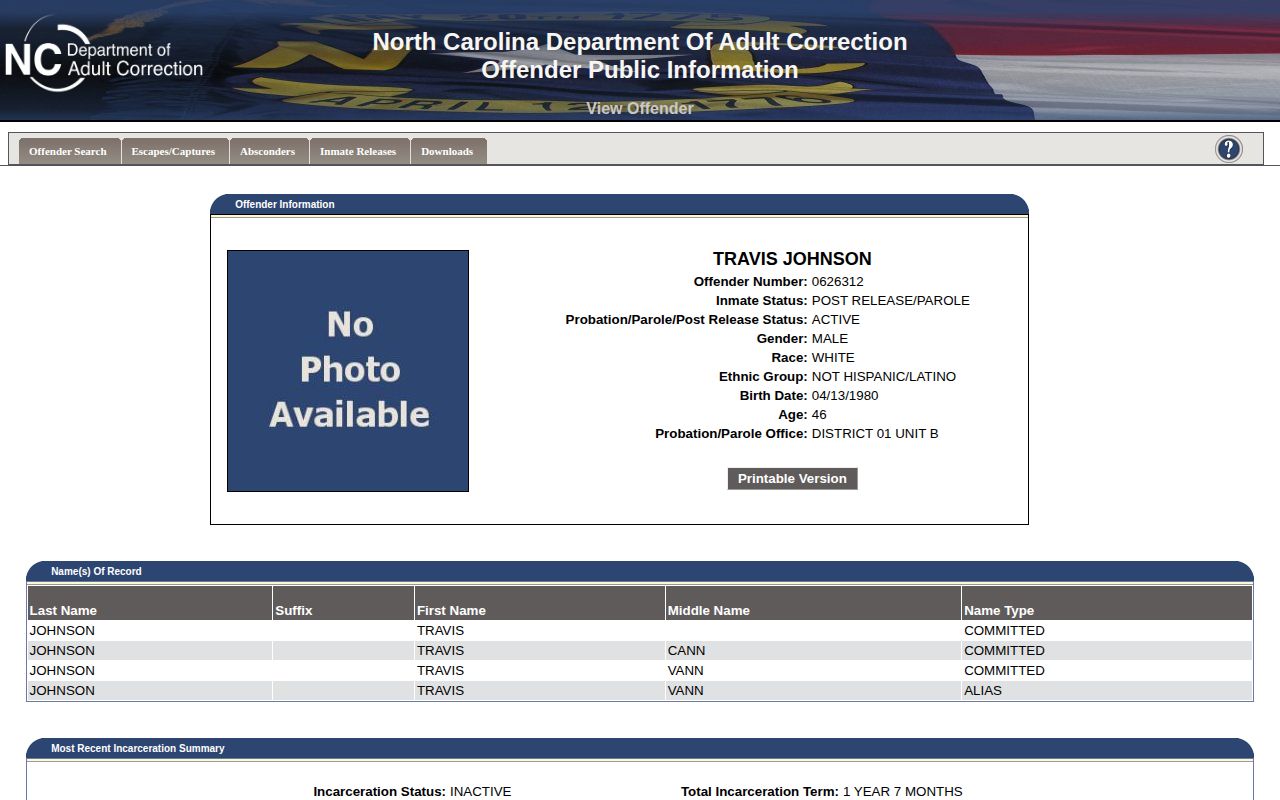
The image shows why incarceration status and community-supervision status must be read on separate lines.
Pasquotank Prison Release Records
NCDAC is the custodian for state prison records. Its public records information says basic conviction, sentence, admission, release-date, and time-served information is available through OPI. Detailed community-supervision records remain confidential under G.S. 15-207. The public record may show a district or unit without exposing a person's reporting schedule or case notes.
State prison and supervision record custodian
Use OPI first for public release fields
Use the NCDAC Public Records channel for existing agency records
A request should name the offender number, full name, date of birth if known, institution, and approximate custody period. Ask for existing records and fields, not a new calculation. Camden Sheriff and Albemarle District Jail do not certify a Pasquotank Correctional Institution discharge merely because the original criminal case began in Camden.
Note: NCDAC covers state custody records; ADJ and Camden Sheriff remain separate custodians for their local files.
Pasquotank Weekday Release Rules
NCDAC normally processes state prison releases Monday through Friday from 8:00 a.m. to 5:00 p.m. Discretionary credits may move a weekend or holiday projected release date to the prior weekday, but they cannot reduce service below the judicial minimum. These are state prison rules and should not be applied to Albemarle District Jail.
Modern earned time can reduce the maximum term for eligible offenses but never below the minimum. Eligible misdemeanants can earn up to four days per month and felons up to nine, depending on assignment or program levels. Disciplinary violations can forfeit credit. Older good time, meritorious time, and discretionary time have different rules, so not all credit should be called good time.
A reader should rely on the current sentence record and NCDAC calculation, not subtract a percentage by hand. The widely cited 85 percent figure describes the relationship between a Structured Sentencing maximum and credit ceiling; it does not authorize cutting 15 percent from any sentence shown on a court page.
Pasquotank Is Not Regional Jail
Albemarle District Jail and Pasquotank Correctional Institution are both associated with Elizabeth City, but only the first is the regional local jail used by Camden. The regional jail grew from a 44-bed facility opened in 1972 to a 248-bed replacement opened at its current site in 2010. Session Law 2026-25 added Chowan to its governance arrangement in July 2026.
None of those regional-jail governance facts changes Pasquotank Correctional Institution's status as an NCDAC prison. A Camden detainee transferred from Albemarle District Jail into NCDAC remains incarcerated, and the state system can place that person at Pasquotank or another appropriate institution. Use the last movement and current institution fields rather than assuming the nearest prison received the person.
The current governance mismatch belongs only to the regional jail. State law identified four participating counties while the jail website still described three when researched. Pasquotank Correctional Institution is not governed by that district-jail commission. Its custody and release records remain with NCDAC, and a Camden arresting agency or court cannot certify the prison's final movement.
Pasquotank Release Holds And Transfers
A pending warrant, charge, or detainer can change what happens at the end of a prison term. NCDAC policy allows sheriff pickup when local legal authority remains. Federal or immigration custody may also follow where lawful. In each case, the actual release field can mark the end of state incarceration while the last movement shows that another agency took custody.
The 2020 ICE Warrant Service Officer memorandum involved Albemarle District Jail, not Pasquotank Correctional Institution. It does not prove a current immigration program at either facility. When immigration transfer is plausible, check the ICE locator for current detention and request records from the responsible agencies. A negative locator result is not historical proof of community release.
The same scope rule applies to federal custody. BOP's locator covers federal imprisonment, while the U.S. Marshals Service can arrange federal pretrial detention through partner facilities. Neither source replaces an NCDAC movement record. Begin with the state record, identify the receiving agency, and then use that agency's system to test whether custody continued.
Note: Confirm both the agency that released the person and the agency named as destination before concluding that custody fully ended.